The Book
Special education is made of small, routine decisions, and each one is shaped by the social systems surrounding the educators who make them.
A child is moved to a more restrictive setting. A behavior is read as defiance rather than distress. A test score is trusted over a parent's account of their own child. None of these requires a villain. Each reflects what the surrounding environment has taught the adults involved to notice, to expect, and to accept as normal. To explain why such patterns recur across very different schools and people, Bryan E. Cichy-Parker and Larry C. Bryant develop ecological socialization theory, their account of how the nested settings around a child socialize the professionals who work within them.
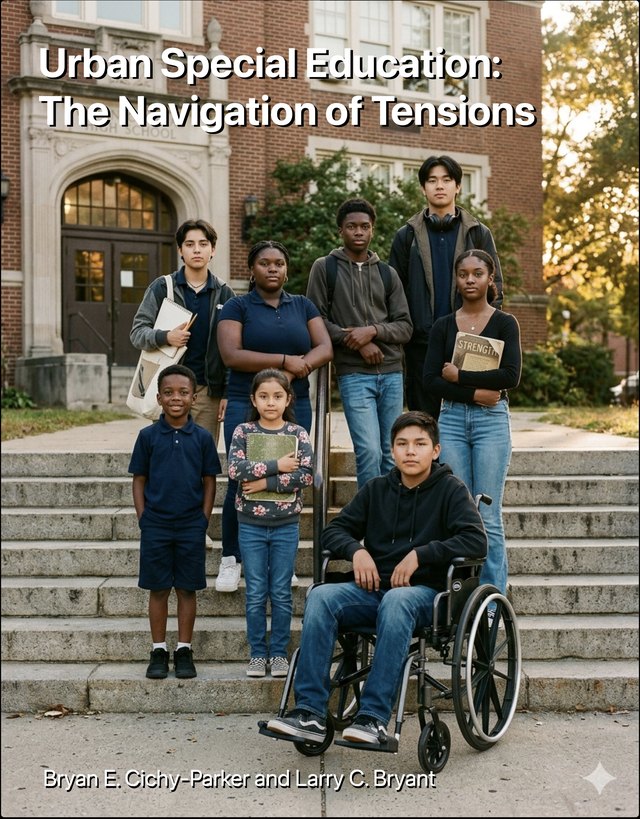
Ecological socialization theory draws together Urie Bronfenbrenner's nested model of human development, symbolic interactionism, Antonio Gramsci's account of hegemony, and the characteristics of White Supremacy Culture, and recasts the settings that surround a child as socialization regimes: environments that teach adults what to see, what to expect, and what to accept as normal. Through this lens, Urban Special Education: The Navigation of Tensions traces eleven tensions running through special education practice, from identification and placement to family partnership and the writing of goals, and locates each one at the ecological level where it actually operates.
The aim is explanatory, not accusatory. The book gives educators a way to see the pressures acting on their own judgment clearly enough to act on them, grounds each tension in a composite student case drawn from recognizable life, and offers a companion reflection tool for testing the theory against the evidence of their own classrooms.
Written for teachers, teacher educators, administrators, and advocates, the book offers an account precise enough to be useful and a stance humane enough to sustain the work: there are no bad actors, only socialized actors.
The central argument
Most accounts of what goes wrong in special education end at intention: better training, better attitudes, better people. Ecological socialization theory starts one level down, at the environments that shape what educators are able to perceive in the first place. It treats the classroom, the school, the district, and the surrounding culture as socialization regimes, each one teaching the adults inside it a version of normal.
Hegemony names how those lessons hold without force. Because the resulting patterns look like ordinary professional judgment, they rarely announce themselves, which is exactly why they persist. Naming the eleven tensions, and the ecological level each one lives at, turns a diffuse sense that something is off into something specific enough to work on.
Inside the book
- Chapters 1–3Foundations: the problem, the model, and how socialization operates
- Chapters 4–14The eleven tensions, each placed at the ecological level where it operates
- Chapter 15Racism as a subset of ecological socialization
- Chapter 16Closing thoughts
Full chapter titles and a sample excerpt will be added closer to launch.
The book is expected in early 2027. Sign up on the home page for occasional updates about the launch and related news.